
- Log in
- 0
Two Racing Stripes: A Small Detail with a Long History
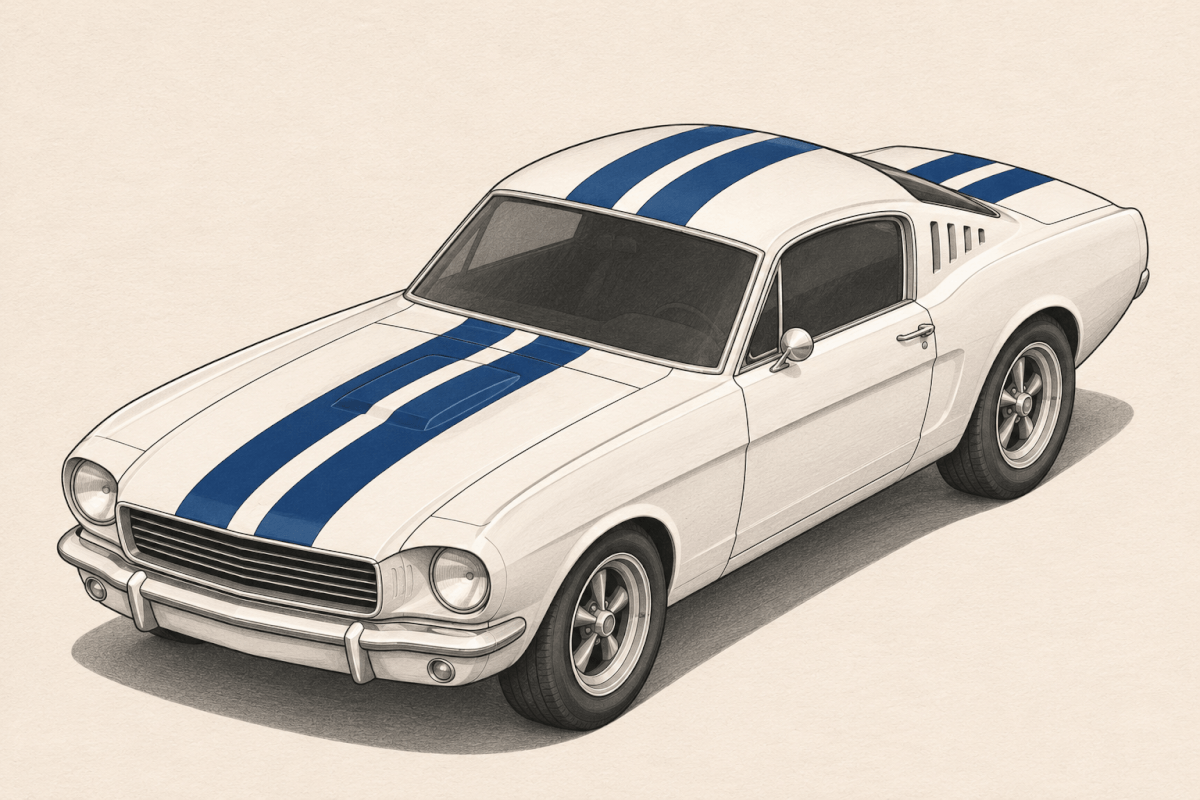
Two blue stripes on a white car can suggest a racing connection before you notice a badge. That familiar look has a story worth knowing—and a detail you might miss when choosing stripes for your own car.
A racing identity that travelled
Briggs Cunningham’s white-and-blue colours appeared on more than cars bearing his name. The Le Mans organiser’s history follows them onto his team’s Corvettes, Maseratis and Jaguars. The visual identity could move between very different body shapes. Read the ACO’s Cunningham history.
The link to the Shelby GT350 comes from its designer himself. Writing in Classic Motorsports, Peter Brock recalls copying Cunningham’s 1951 Le Mans livery onto his own 1946 Ford, then using those stripes for the GT350. It is a small, personal link between a teenage enthusiast’s car and a much better-known design. Read Brock’s account.
The stripes were not one width everywhere
Here is the useful surprise. In his history for The Shelby American, Rick Kopec explains that the familiar “ten-inch” description was shorthand: the 1965–66 Shelby stripe layout used different widths across the body. He describes the taper as a way to avoid the uneven appearance produced by a constant-width layout. See the illustrated archive article, page 131.
Those historical measurements belong to that layout; they are not a sizing recipe for another car. The interesting lesson is to judge the stripe against the whole body, rather than choose by a width number alone.
Look at the space between the stripes, too
For a modern design, we would start with three visual choices:
- The centre gap. Notice the body-colour space between the bands. Compare it with each stripe’s width; it is part of the pattern, not leftover space.
- The route over the body. Look at front, side and rear views. Decide whether you want a hood accent or a composition that continues across the roof and rear deck.
- The intended reference. A historically faithful recreation needs a reference for that exact car and period. A design inspired by racing leaves room to choose different colours and proportions.
Try comparing two layouts on the same photograph before settling on one. Keep the vehicle and viewing angle unchanged so the graphic is the difference you are judging. This is a design comparison, not a claim about performance.
Explore SupDec’s racing-stripe designs for ideas. Once a layout catches your eye, use our vehicle details and fitment checklist to prepare the next step.